
Don't Let Our Cute
Smiles Fool You.
We WIN Legal Fights!
Smiles Fool You.
We WIN Legal Fights!



The sight of a blue and white Amazon delivery van is a daily occurrence on the streets of Galveston. While this convenience is a staple of modern life, the increased presence of commercial delivery vehicles introduces significant risks to other drivers, motorcyclists, cyclists, and pedestrians. When the pressure to meet demanding delivery quotas leads to negligence, a devastating accident can occur in an instant. For victims, the path to recovery is often complicated by severe injuries, mounting medical bills, and a confusing battle against a corporate giant.
Galveston’s unique blend of residential neighborhoods, bustling tourist districts like the Strand, and industrial port traffic creates a complex environment for any driver. The explosion of e-commerce has flooded these already congested streets with Amazon delivery vans and trucks. This surge means more commercial vehicles are navigating narrow streets, making frequent stops, and operating under tight deadlines, increasing the probability of accidents.
Unlike passenger cars, Amazon delivery vehicles—from Sprinter vans to larger trucks—have significant blind spots, greater mass, and longer stopping distances. Drivers are often under immense pressure, potentially leading to unsafe behaviors like speeding, distracted driving while using navigation devices, or aggressive maneuvering to stay on schedule. These factors combine to make any collision with a commercial delivery truck particularly dangerous.
If you have been injured in an accident involving an Amazon driver in Galveston, you are facing more than just a typical car crash claim. You are up against a complex corporate structure designed to minimize liability. This guide provides essential information about your rights, the unique challenges of these cases, and the steps you must take to protect your claim and secure the compensation you deserve under Texas law.
An accident involving an Amazon delivery vehicle in Galveston is not just another traffic incident. It occurs at the intersection of local geography, intense corporate pressure, and complex legal frameworks. Understanding these interconnected factors is the first step in building a strong personal injury claim.
Galveston’s roadway system presents distinct challenges. The Galveston Causeway creates a bottleneck for traffic entering and leaving the island. Tourist seasons bring a surge of unfamiliar drivers and pedestrians, particularly around Seawall Boulevard and the cruise terminals. Furthermore, coastal weather can quickly create hazardous road conditions. Amazon drivers navigating these variables under time constraints are more susceptible to making critical errors.
Amazon utilizes a sophisticated logistics network that often insulates the parent company from direct liability. Many drivers work for independent Delivery Service Partners (DSPs) or as gig-economy “Flex” drivers. While these drivers wear Amazon uniforms and operate Amazon-branded vehicles, they are technically contractors. This model places extreme performance demands, such as strict delivery quotas and constant digital monitoring, which can directly contribute to driver fatigue, distraction, and unsafe driving practices.
Several recurring scenarios result in accidents on Galveston’s roads. These include drivers failing to yield when pulling out from a parked position on a residential street, making abrupt or illegal U-turns to find an address, speeding through neighborhoods to meet deadlines, and rear-ending vehicles in stop-and-go tourist traffic. Distracted driving, fueled by the need to interact with scanning devices and GPS, is another primary cause.
The sheer size and weight difference between a commercial delivery van and a standard passenger vehicle, motorcycle, or pedestrian means that collisions often result in catastrophic, life-altering injuries for the victim. The physical, emotional, and financial toll can be overwhelming.
Even a low-speed impact from a loaded delivery van can cause devastating harm. Common injuries include traumatic brain injuries (TBIs), spinal cord damage leading to paralysis, compound fractures, internal organ damage, and severe soft tissue injuries like whiplash. For pedestrians and cyclists, the outcome is frequently fatal, leading to wrongful death claims.
Catastrophic injuries require more than just emergency medical care. Victims often face a future filled with surgeries, long-term rehabilitation, physical therapy, chronic pain management, and the need for assistive medical devices. A TBI, for example, can result in permanent cognitive deficits, personality changes, and a complete loss of independence, requiring lifelong care.
Beyond the physical pain, severe injuries profoundly impact a victim’s quality of life. The inability to work leads to lost income and a diminished future earning capacity, placing immense financial strain on the entire family. Hobbies, recreational activities, and personal relationships can all be negatively affected, leading to depression, anxiety, and a significant loss of enjoyment of life.
Determining who is legally and financially responsible for your injuries is one of the most complex aspects of an Amazon truck accident claim. Amazon has intentionally structured its delivery network to create legal distance between itself and the actions of its drivers, but this corporate shield is not impenetrable.
When an accident occurs, you may be dealing with multiple potential defendants. The at-fault party could be the individual driver, the DSP that employs them, a third-party company responsible for vehicle maintenance, or Amazon itself. Amazon will almost certainly argue that it is not the employer and therefore not responsible. However, arguments can be made that Amazon exerts sufficient control over its DSPs and drivers to be held vicariously liable for their negligence.
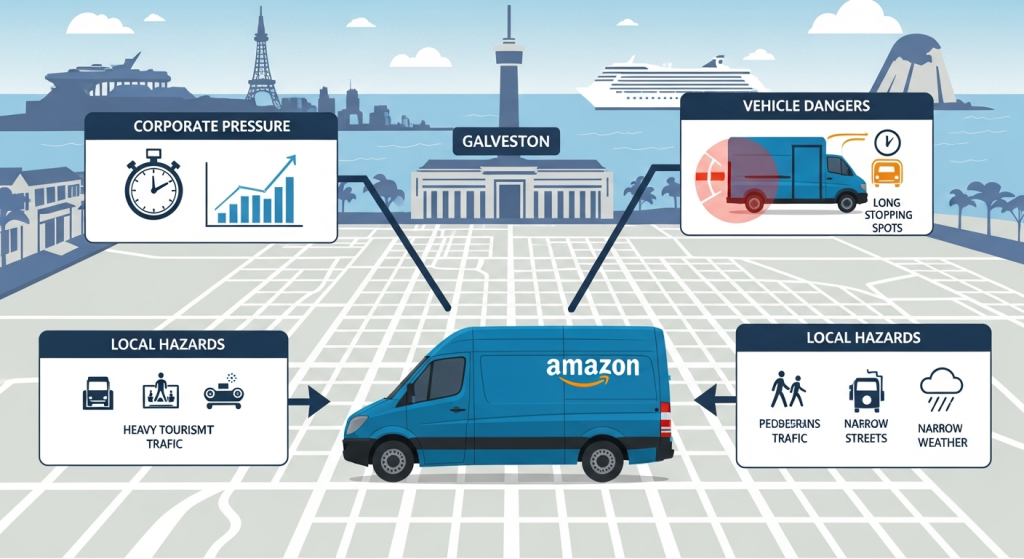
A combination of corporate pressure, inherent vehicle dangers, and unique Galveston traffic conditions creates a high-risk environment for accidents.
To succeed in a personal injury claim in Texas, you must prove that another party’s negligence caused your injuries. This involves demonstrating four key elements:
Building a strong case requires gathering critical evidence immediately. This includes the official police report, photos and videos of the accident scene, eyewitness statements, and your medical records. Crucially, it also involves securing evidence specific to the commercial driver, such as their driving history, employment records, vehicle maintenance logs, and electronic data from the delivery vehicle itself, which can show speed, braking, and GPS location.
The actions you take in the minutes, hours, and days following an accident are critical for protecting your health and your legal rights. Staying calm and proceeding methodically can significantly impact the outcome of your future personal injury claim.
Under Texas law, victims of negligence are entitled to seek compensation, known as damages, for the harm they have suffered. In a complex commercial vehicle accident case, this includes a wide range of economic and non-economic losses.
Economic damages are tangible, calculable financial losses resulting from the accident. A thorough claim will seek recovery for:
Non-economic damages compensate victims for the intangible, subjective harm caused by the accident. While harder to quantify, they are a critical component of a fair settlement. These include compensation for:
In some cases where the defendant’s conduct was particularly reckless or malicious (e.g., a driver was intoxicated, or a company knowingly used unsafe vehicles), a Texas court may award punitive damages. These are intended not to compensate the victim, but to punish the wrongdoer and deter similar conduct in the future.
The total value of your claim depends on several factors, including the severity of your injuries, the total amount of your economic losses, the long-term impact on your life and ability to work, and the strength of the evidence proving the other party’s negligence. The available insurance policy limits can also play a significant role.
Facing a corporate entity like Amazon and its team of aggressive insurance adjusters and lawyers on your own is a monumental task. An experienced local attorney levels the playing field and ensures your rights are protected throughout the entire process.
An experienced lawyer understands the specific state and federal regulations that apply to commercial drivers and their employers. They know how to navigate the Texas Civil Practice and Remedies Code and use the law to build a compelling case for negligence and liability.
Amazon and its insurance carriers handle these claims every day. Their primary goal is to minimize their payout or deny the claim altogether. A dedicated lawyer knows their tactics and can counter them effectively, managing all communications and negotiations on your behalf so you can focus on your recovery.
A skilled attorney will conduct a thorough investigation to calculate the full, long-term cost of your injuries. They may work with medical experts, economists, and accident reconstructionists to accurately value your claim and ensure no future needs are overlooked, fighting to secure the maximum compensation possible.
A Galveston-based lawyer possesses invaluable local knowledge. They are familiar with the local courts, judges, and legal community. They understand the specific traffic patterns and accident-prone areas on the island, and they have access to local resources and experts who can strengthen your case. This localized expertise can make a significant difference in the outcome of your claim.
An experienced personal injury attorney in Harris County, Galveston County, Fort Bend County, Montgomery County, Brazoria County, Houston, Sugar Land, Missouri City, and Stafford, Texas at Thornton Esquire Law Group, PLLC will take over the case from the very beginning and make sure that you receive fair compensation for your injuries. A personal injury lawyer will help you recover medical expenses, lost wages, pain and suffering, and other losses due to the accident. Contact us today at www.thorntonesquirelawgroup.com for a free case evaluation consultation.

Click on the button below to login.