
Don't Let Our Cute
Smiles Fool You.
We WIN Legal Fights!
Smiles Fool You.
We WIN Legal Fights!




In the thriving community of Sugar Land, Texas, life moves quickly. Amidst the suburban growth and bustling commercial activity, an unexpected accident can bring everything to a halt. A sudden injury caused by someone else’s negligence can be a disorienting and overwhelming experience, thrusting victims and their families into a world of medical bills, lost income, and profound uncertainty. Understanding your rights and the legal pathways available is the first, most crucial step toward regaining control and seeking the justice you deserve.
This guide is designed to provide clarity and direction for those navigating the complexities of a personal injury claim in Sugar Land. It will explore the fundamentals of Texas law, common types of accidents in our area, the damages you may be entitled to recover, and the vital role a local attorney plays in protecting your interests.
The immediate aftermath of an accident is often chaotic. Beyond the physical pain, victims face a cascade of challenges. Medical treatments, follow-up appointments, and rehabilitation can consume time and energy. The inability to work can lead to significant financial strain, while the emotional toll of trauma, stress, and anxiety can be just as debilitating as the physical injuries. This multifaceted impact underscores the importance of a comprehensive approach to recovery—one that addresses not only physical healing but also financial stability and emotional well-being.
A personal injury claim is a legal recourse that allows an injured person to seek compensation from the party responsible for their harm. The goal is to “make the victim whole” again, at least from a financial perspective, by covering the losses incurred due to the accident. This process can seem daunting, involving insurance companies, legal deadlines, and complex procedural rules. However, with the right knowledge and guidance, victims can effectively assert their rights and pursue a fair outcome.
Navigating a personal injury claim successfully requires a firm grasp of the legal principles that govern these cases in Texas. From defining what constitutes an injury to proving fault, state-specific laws play a pivotal role in the outcome of your case.
In a legal context, a “personal injury” refers to any harm inflicted on a person’s body, mind, or emotions, as opposed to damage to property. This broad category encompasses everything from cuts and broken bones sustained in a car crash to long-term psychological trauma. The core of a personal injury claim is establishing that this harm was a direct result of the negligent, reckless, or intentional actions of another party.
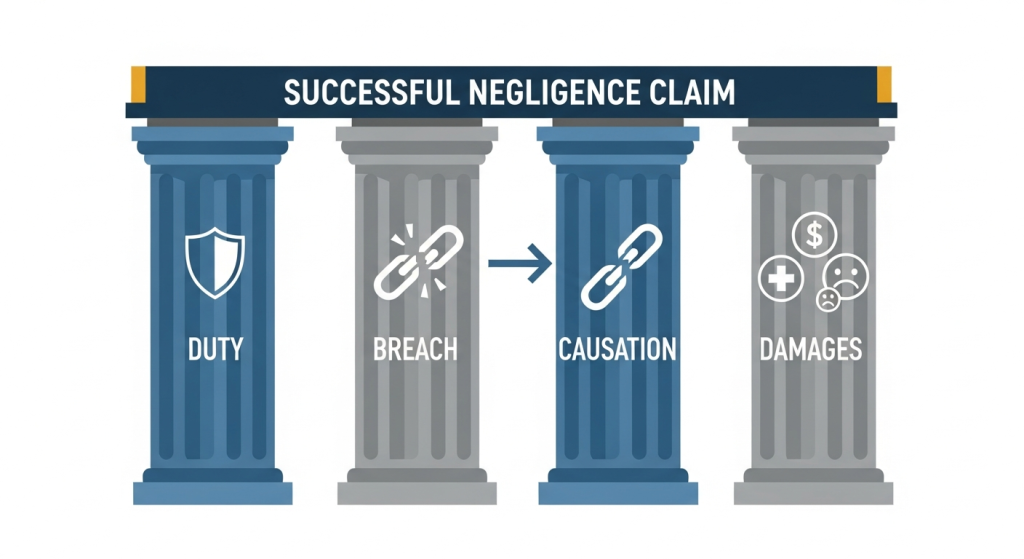
To prove negligence in Texas, a claimant must establish these four essential elements.
Most personal injury cases in Texas are built on the legal concept of negligence. To win a negligence claim, the injured party (the plaintiff) must prove four specific elements:
Successfully proving all four elements is essential for a successful claim.
Two critical Texas laws directly influence personal injury cases. The first is the statute of limitations, which generally gives an injured person two years from the date of the accident to file a lawsuit. Failing to file within this timeframe can permanently bar you from seeking compensation.
The second is the doctrine of modified comparative negligence, also known as proportionate responsibility. Under this rule (Texas Civil Practice and Remedies Code § 33.001), you can still recover damages even if you were partially at fault for the accident, as long as your share of the blame is 50% or less. However, your total compensation will be reduced by your percentage of fault. If you are found to be 51% or more at fault, you cannot recover any damages.
As a dynamic and growing city in Fort Bend County, Sugar Land sees a variety of accidents that can lead to serious injuries. Understanding these common scenarios helps residents recognize potential risks and know when to seek legal counsel.
With major thoroughfares like U.S. 59 and Highway 6, traffic accidents are a significant concern. In 2023 alone, there were 653 crashes in Sugar Land that involved injuries. These incidents include passenger car collisions, devastating commercial truck accidents, and accidents involving motorcyclists, bicyclists, and pedestrians who are especially vulnerable. The proximity to Houston, a city that recorded 67,644 total crashes in 2023, further contributes to the high volume of traffic and associated risks. Drunk driving remains a serious problem, with alcohol-impaired drivers causing 25% of all traffic fatalities in Texas.
Property owners in Texas have a legal duty to maintain a reasonably safe environment for visitors. When they fail to do so, and someone is injured as a result, a premises liability claim may arise. Common examples include slip-and-fall accidents caused by wet floors or uneven pavement, injuries from falling objects, dog bites, or assaults resulting from negligent security at commercial establishments.
While many on-the-job injuries are covered by workers’ compensation, not all Texas employers carry this insurance. When an employer is a non-subscriber or a third party (like a subcontractor or equipment manufacturer) is responsible for the injury, a personal injury lawsuit may be necessary. Texas has a higher-than-average workplace fatality rate, at 4.1 per 100,000 full-time employees compared to the national rate of 3.5. While nonfatal cases have trended down, Texas private industry workplaces still saw 178,800 incidents of nonfatal injuries or illnesses in 2022.
Consumers have a right to expect that the products they purchase are safe for their intended use. When a product with a design flaw, manufacturing defect, or inadequate warning label causes an injury, the manufacturer, distributor, or seller can be held liable through a product liability claim.
Some accidents result in catastrophic injuries, such as traumatic brain injuries (TBIs), spinal cord damage, severe burns, or amputations. These injuries have life-altering consequences, requiring extensive medical care and permanently affecting a person’s ability to work and enjoy life. In the most tragic cases, negligence leads to a fatality, giving surviving family members the right to file a wrongful death lawsuit to seek justice and compensation for their profound loss.
In a Texas personal injury case, “damages” refer to the monetary compensation awarded to the victim to cover their losses. These are categorized into three main types, each designed to address a different aspect of the harm suffered.
Economic damages are the tangible, out-of-pocket costs associated with an injury. They are meant to reimburse the victim for all financial losses and can be calculated by adding up bills, receipts, and pay stubs. Common examples include:
Non-economic damages compensate for the intangible, non-financial consequences of an injury. While harder to quantify, they are a critical component of a claim as they acknowledge the profound human cost of an accident. These include:
Punitive damages, also known as exemplary damages, are not intended to compensate the victim. Instead, they are awarded in rare cases to punish the defendant for particularly egregious conduct, such as gross negligence or malice. Their purpose is to deter the defendant and others from similar behavior in the future.
Facing a personal injury claim alone can be a significant disadvantage. Insurance companies have teams of adjusters and lawyers dedicated to minimizing payouts. An experienced attorney levels the playing field, advocating solely for your best interests.
A skilled personal injury attorney manages every aspect of your case, allowing you to focus on your recovery. They handle complex legal procedures, gather crucial evidence, identify all liable parties, and calculate the full value of your claim, including future damages. Most importantly, they act as your shield against insurance company tactics designed to devalue your claim or pressure you into a low settlement.
The legal process typically involves several key stages:
The actions you take in the minutes, hours, and days following an accident can have a significant impact on your health and your potential legal claim.
If you are able, prioritize safety first. Move to a safe location if possible, call 911 to report the incident and request medical assistance, and exchange contact and insurance information with any other parties involved. Use your phone to take photos and videos of the scene, your injuries, and any property damage.
Seek a medical evaluation as soon as possible, even if you feel fine. Some serious injuries, like concussions or internal bleeding, may not have immediate symptoms. A medical professional can diagnose your injuries and create an official record linking them to the accident, which is vital for your claim. Follow all prescribed treatment plans and attend all follow-up appointments.
After an accident, you will likely be contacted by an insurance adjuster from the at-fault party’s company. Be cautious. You are only obligated to provide basic information. Avoid giving a recorded statement, speculating on fault, or accepting an early settlement offer without first consulting an attorney. These offers are almost always far less than what your claim is actually worth.
It is advisable to contact a personal injury attorney as soon as possible after your accident. An early consultation allows your legal team to preserve critical evidence, speak to witnesses while their memories are fresh, and guide you away from common mistakes that could harm your case.
When seeking legal representation, choosing a firm with deep roots in the community offers distinct advantages.
A local Sugar Land law firm possesses an intimate knowledge of the area’s roads, businesses, and court systems. They are familiar with the judges and opposing counsel in Fort Bend County and understand the specific local factors that can influence a case. This hyper-local expertise, combined with a comprehensive understanding of Texas personal injury law, provides a strategic edge.
Local firms are often more invested in the well-being of their community and its residents. They provide a personalized, client-centered approach, ensuring you are not just another case number. This means direct communication with your attorney, compassionate guidance, and a legal strategy tailored to your unique circumstances and goals.
Sustaining a personal injury in Sugar Land can disrupt your life in countless ways, but you do not have to face the journey to recovery alone. Understanding your legal rights under Texas law is the first step toward securing the resources needed to heal and rebuild. From proving negligence and navigating insurance negotiations to calculating the full extent of your damages, the legal process is complex and demands professional skill.
Taking decisive action by preserving evidence, seeking medical care, and consulting with a knowledgeable local personal injury attorney can protect your rights and set the stage for a successful outcome. By choosing a dedicated advocate who understands the intricacies of both Sugar Land and Texas law, you empower yourself to pursue the full and fair compensation you are owed. Your path forward starts with seeking trusted legal counsel to champion your cause and fight for the justice you deserve.
An experienced personal injury attorney in Harris County, Galveston County, Fort Bend County, Montgomery County, Brazoria County, Houston, Sugar Land, Missouri City, and Stafford, Texas at Thornton Esquire Law Group, PLLC will take over the case from the very beginning and make sure that you receive fair compensation for your injuries. A personal injury lawyer will help you recover medical expenses, lost wages, pain and suffering, and other losses due to the accident. Contact us today atwww.thorntonesquirelawgroup.com for a free case evaluation consultation.

Click on the button below to login.