
Don't Let Our Cute
Smiles Fool You.
We WIN Legal Fights!
Smiles Fool You.
We WIN Legal Fights!



An unexpected injury can turn your world upside down in an instant. One moment, life is proceeding as normal; the next, you are facing physical pain, mounting medical bills, and an uncertain future. When an injury is caused by someone else’s carelessness or negligence, the situation becomes even more complex, fraught with questions about justice and financial recovery. In the Lone Star State, a specific set of laws governs these situations, designed to help victims seek compensation and hold responsible parties accountable.
Navigating the aftermath of an accident is a daunting task. This comprehensive guide is designed to demystify personal injury law in Texas. We will explore what constitutes a personal injury, the types of accidents that commonly occur, the critical legal principles that will shape your case, and the step-by-step process of pursuing a claim. Understanding your rights is the first and most crucial step toward protecting your well-being and securing your future.
Personal injury law, also known as tort law, provides a legal framework for individuals to seek compensation when they have been harmed by the wrongful actions of another person, company, or entity. It is a civil action, distinct from criminal law, focused not on punishment but on making the injured party “whole” again, primarily through financial recovery.
A personal injury case arises when one person suffers harm from an accident or injury for which someone else is legally responsible. The harm is not limited to physical pain. It encompasses a wide range of damages, including emotional and psychological trauma, financial losses from medical treatment and missed work, and the loss of enjoyment of life. The core of any personal injury claim is the concept of negligence—the failure of an individual or entity to exercise a reasonable level of care, resulting in injury to another.
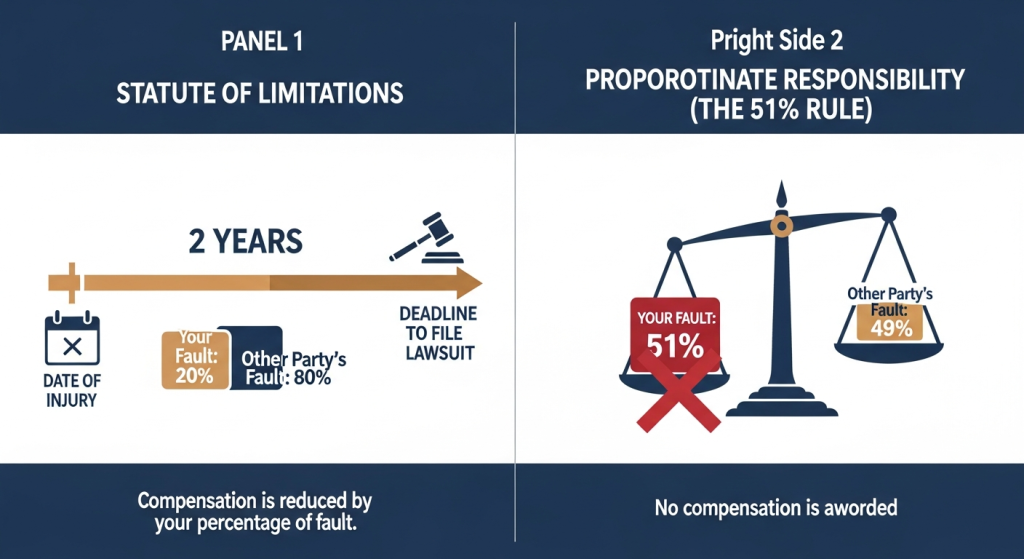
Texas law sets a strict two-year deadline for filing most injury claims and follows a ‘proportionate responsibility’ rule for shared fault.
Texas law is built on several key principles that govern how personal injury cases are handled. The most fundamental is the statute of limitations, which sets a strict deadline for filing a lawsuit. In most Texas personal injury cases, you have two years from the date of the injury to initiate legal action. Another crucial principle is “proportionate responsibility,” which determines how compensation is handled if the injured person is partially at fault for the accident. Understanding these foundational rules is essential, as they can significantly impact your ability to recover damages.
Texas is a bustling state with major highways, sprawling cities, and significant industrial activity, all of which contribute to a variety of accident types. While any incident caused by negligence can lead to a claim, some occur with more frequency and present unique legal challenges.
Roadways in Texas are notoriously dangerous. In 2023 alone, Texas experienced 4,291 traffic fatalities, tragically marking another year with no death-free days on its roads. Major metropolitan areas are hotspots for collisions; for example, Houston reported a staggering 67,644 total crashes in 2023. These accidents are frequently caused by distracted driving, speeding, driving under the influence, and other forms of driver negligence.
Given its central role in national commerce, Texas sees a high volume of commercial truck traffic. Accidents involving 18-wheelers are often catastrophic due to the immense size and weight difference between a commercial truck and a passenger vehicle. These cases are legally complex, often involving federal trucking regulations, multiple liable parties (driver, trucking company, maintenance provider), and sophisticated evidence like electronic logbooks and vehicle maintenance records.
Motorcyclists and pedestrians lack the structural protection of an enclosed vehicle, making them exceptionally vulnerable to severe injuries in a collision. Drivers often fail to see them or misjudge their speed and distance. These cases frequently involve catastrophic injuries, such as traumatic brain injuries, spinal cord damage, and extensive fractures, requiring lifelong medical care.
Texas’s robust energy sector, including its many oilfields and offshore drilling operations, presents unique dangers. Workers in these high-risk environments face hazards from heavy machinery, explosive materials, and demanding conditions. Personal injury claims in this sector can involve complex federal maritime laws (like the Jones Act for offshore workers) and stringent industry safety regulations.
Other significant sources of personal injury claims include bus accidents, which can involve public transit or private charter companies; workplace accidents across various industries; and premises liability cases. Premises liability, commonly known as “slip and fall,” holds property owners responsible for injuries caused by unsafe conditions on their property, such as wet floors, poor lighting, or inadequate security. While some industries are seeing improvements, such as the 20% reduction in serious construction injury claims in 2024, Texas still has a high rate of workplace incidents. In 2023, there were 564 fatal occupational injuries in the state, underscoring the ongoing risks workers face.
The foundation of a successful personal injury claim in Texas is proving that another party was negligent and that their negligence directly caused your injuries. This involves establishing four specific legal elements.
First, you must prove that the defendant owed you a “duty of care.” This is a legal obligation to act with a certain level of caution to avoid harming others. For example, every driver on the road has a duty to operate their vehicle safely and obey traffic laws. A property owner has a duty to maintain a reasonably safe environment for visitors.
Once a duty of care is established, you must demonstrate the following:
Texas follows a “proportionate responsibility” rule, also known as modified comparative fault. Under this system (Texas Civil Practice and Remedies Code § 33.001), you can still recover damages even if you were partially at fault for the accident, as long as your share of the blame is 50% or less. However, your total compensation will be reduced by your percentage of fault. For example, if you are awarded $100,000 but are found to be 20% at fault, your award will be reduced to $80,000. If you are found to be 51% or more at fault, you are barred from recovering any damages at all.
A strong personal injury case is built on solid evidence. This includes police reports, photographs and videos of the accident scene and your injuries, witness statements, medical records, and expert testimony. Preserving this evidence immediately following an accident is crucial for proving negligence and the full extent of your damages.
The primary goal of a personal injury claim is to secure compensation, known as damages, for the harm you have suffered. Texas law categorizes damages into three main types.
Economic damages are tangible, calculable financial losses resulting from your injury. This category includes:
Non-economic damages compensate you for the intangible, non-financial consequences of your injury. These are subjective but very real losses, including:
In rare cases, a court may award punitive damages, known in Texas as “exemplary damages.” These are not intended to compensate the victim but rather to punish the defendant for particularly egregious behavior, such as gross negligence or malice, and to deter similar conduct in the future.
The value of a personal injury claim varies dramatically based on the severity of the injuries, the clarity of fault, and the strength of the evidence. While the average verdict in a Texas personal injury lawsuit is $826,892, the median award is just $12,281. This vast difference highlights that a few very high awards can skew the average, while most cases resolve for more modest amounts. An experienced attorney can help build a case aimed at securing the maximum compensation available for your specific circumstances.
The journey from injury to resolution can be long and complex. Understanding the key stages of the process can help you feel more prepared and in control.
The actions you take immediately after an accident are critical. First, seek medical attention, even if your injuries seem minor. Second, report the incident to the appropriate authorities (e.g., police, property manager). Third, document everything: take photos, get contact information from witnesses, and write down your recollection of events.
Most personal injury attorneys offer a free initial consultation. During this meeting, the attorney will review the facts of your case, evaluate its potential strengths and weaknesses, and advise you on your legal options.
If you and the attorney decide to move forward, their team will launch a thorough investigation. This involves gathering all relevant evidence, such as police reports, medical records, and witness statements, and may include hiring experts to reconstruct the accident or assess future medical needs.
Your attorney will handle all communications with the at-fault party’s insurance company. Insurance adjusters are trained to minimize payouts. Your lawyer’s role is to protect you from lowball offers and ensure your claim is presented in the strongest possible light.
If a fair settlement cannot be reached with the insurance company, the next step is to file a personal injury lawsuit. This formally begins the litigation process and compels the defendant to respond in court.
After a lawsuit is filed, the “discovery” phase begins, where both sides exchange information and evidence. This may involve written questions (interrogatories), requests for documents, and depositions (sworn out-of-court testimony). Many cases are then referred to mediation, a structured negotiation process led by a neutral third party, in an attempt to reach a settlement.
The vast majority of personal injury cases are resolved through a settlement before reaching a trial. A settlement is a voluntary agreement to resolve the case for a specific amount of money. Going to trial is riskier and more expensive, but it may be necessary if the opposing party refuses to make a fair settlement offer.
If the case proceeds to trial, both sides will present their evidence and arguments to a judge or jury. The trial can last a day, a week, or longer, depending on its complexity. The jury will then deliberate and deliver a verdict.
It is impossible to overstate the importance of the statute of limitations. In Texas, you generally have only two years from the date of your injury to file a lawsuit. If you miss this deadline, you will almost certainly lose your right to seek compensation forever. There are very few exceptions, making it imperative to act quickly after an accident.
Sustaining a personal injury due to another’s negligence can be a devastating experience, creating significant physical, emotional, and financial burdens. The Texas legal system provides a clear path to seek justice and compensation, but this path is filled with complex rules, strict deadlines, and adversarial insurance companies. To successfully navigate this landscape, it is vital to understand the core principles of negligence, the types of damages you can recover, and the critical two-year statute of limitations that governs your claim.
Protecting your rights begins with prompt action. Seek immediate medical care, document the incident thoroughly, and avoid making recorded statements to insurance adjusters without legal guidance. Most importantly, consult with an experienced Texas personal injury attorney who can evaluate your case, manage the intricate legal process, and advocate tirelessly on your behalf. By taking these decisive steps, you can focus on your recovery while ensuring you are in the strongest possible position to secure the full and fair compensation you deserve.
An experienced personal injury attorney in Harris County, Galveston County, Fort Bend County, Montgomery County, Brazoria County, Houston, Sugar Land, Missouri City, and Stafford, Texas at Thornton Esquire Law Group, PLLC will take over the case from the very beginning and make sure that you receive fair compensation for your injuries. A personal injury lawyer will help you recover medical expenses, lost wages, pain and suffering, and other losses due to the accident. Contact us today atwww.thorntonesquirelawgroup.com for a free case evaluation consultation.

Click on the button below to login.