
Don't Let Our Cute
Smiles Fool You.
We WIN Legal Fights!
Smiles Fool You.
We WIN Legal Fights!



Galveston, Texas, is a unique blend of historic charm, bustling tourism, and vital industry. From the sun-drenched beaches along the Seawall to the thriving Port of Galveston, the island attracts millions of visitors and supports a robust workforce. However, this dynamic environment also presents a wide array of risks. A leisurely vacation or a routine workday can be instantly disrupted by an accident, leaving individuals with serious injuries, mounting medical bills, and an uncertain future. When an injury is caused by the negligence of another person or entity, victims have the right to seek compensation through a personal injury claim. Navigating this complex legal process requires a clear understanding of Texas law and the specific factors at play in the Galveston area.
A personal injury claim is a legal dispute that arises when one person suffers harm from an accident or injury, and someone else might be legally responsible for that harm. The core of most personal injury cases is the concept of negligence. The claim process allows the injured party (the plaintiff) to seek financial compensation, known as damages, from the at-fault party (the defendant) or their insurance company. This compensation is intended to cover the various losses stemming from the injury, including medical expenses, lost income, and pain and suffering.
Filing a personal injury claim in Galveston involves more than just understanding general Texas law. The island’s specific characteristics introduce unique variables. The constant influx of tourists can lead to traffic congestion and accidents involving out-of-state drivers. The maritime industry presents specialized claims governed by federal laws like the Jones Act. Beachfront hotels and restaurants have a high duty of care to prevent slip-and-fall incidents. Even the coastal weather can play a role in premises liability cases. An effective legal strategy must account for these local factors to build a compelling and successful claim.
The legal framework governing personal injury claims in Texas is intricate, built upon foundational principles of negligence and liability. Successfully navigating a claim requires proving that another party was at fault for the injuries sustained. This process is guided by established legal concepts and specific state statutes that outline the rights and responsibilities of all involved parties.
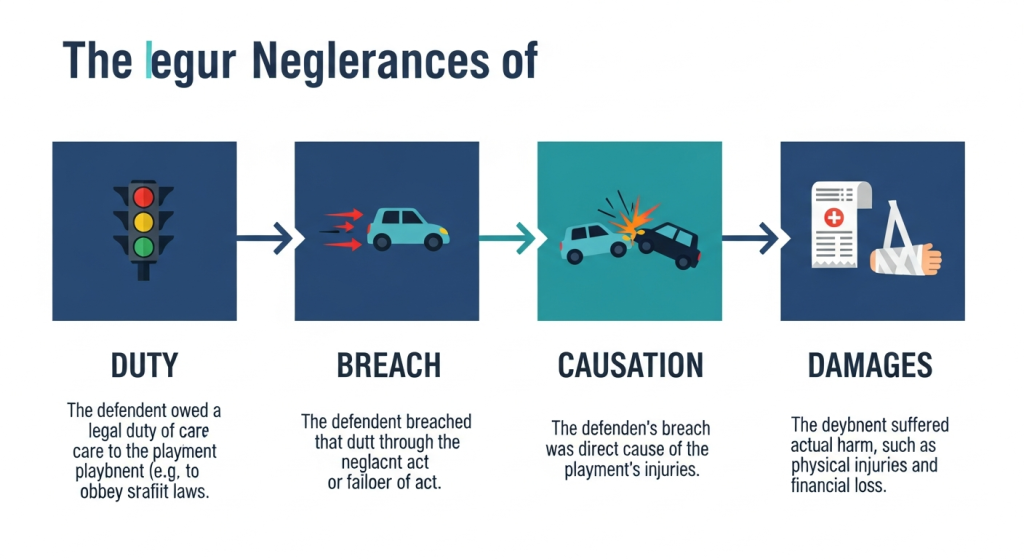
Proving a personal injury claim requires establishing these four key elements of negligence.
To win a personal injury case in Texas, the injured party must prove four key elements of negligence:
Without proving all four elements, a negligence claim will not succeed.
Liability refers to the legal responsibility for an accident and the resulting damages. The “legal duty of care” is the standard of reasonable care an individual or entity must adhere to while performing any acts that could foreseeably harm others. This duty varies by context. A property owner in Galveston has a duty to maintain a safe environment for visitors, a doctor has a duty to provide care that meets professional standards, and a manufacturer has a duty to produce safe products. Establishing the specific duty of care owed in a particular situation is a critical first step in any personal injury lawsuit.
The Texas Civil Practice and Remedies Code is the body of state law that provides the rules and procedures for personal injury lawsuits. One of the most important principles within this code is the rule of “modified comparative fault,” also known as proportionate responsibility. Under Section 33.001, an injured person can only recover damages if their percentage of fault is 50% or less. If they are found to be 51% or more at fault for the accident, they are barred from recovering any compensation. If they are found partially at fault (e.g., 20%), their total damage award will be reduced by that percentage. This statute makes the allocation of fault a central issue in many Texas injury cases.
Galveston’s diverse activities and industries create a landscape where various types of accidents can occur. From its busy roadways to its commercial waterways and construction sites, understanding the common categories of injury claims is essential for residents and visitors alike.
Traffic accidents are a leading cause of personal injuries. Galveston’s combination of local commuters, commercial trucks servicing the port, and tourist traffic on roads like I-45 and Seawall Boulevard creates a high-risk environment. These collisions can involve passenger cars, large commercial trucks, motorcycles, and vulnerable road users like bicyclists and pedestrians. Proving fault in these cases often involves analyzing police reports, witness testimony, and traffic camera footage.
Property owners and managers have a legal obligation to keep their premises reasonably safe for visitors. When they fail to do so, and an injury occurs, it can lead to a premises liability claim. Common examples in Galveston include slip and falls in restaurants or grocery stores due to wet floors, trip and falls on uneven sidewalks in the historic Strand District, or injuries caused by inadequate security at a hotel or apartment complex.
Given its location on the Gulf of Mexico, Galveston is a hub for both recreational boating and commercial maritime activity. Boating accidents can result from operator inexperience, intoxication, or equipment failure. For those injured while working on vessels or at the port, claims may fall under complex federal maritime laws, such as the Jones Act, which provides protections for seamen, or the Longshore and Harbor Workers’ Compensation Act for other maritime employees.
Beyond the maritime sector, Galveston’s economy includes construction and other industrial jobs where workers face significant risks. Construction sites are particularly hazardous, with potential for falls from heights, equipment malfunctions, and accidents involving heavy machinery. While many workplace injuries are covered by workers’ compensation, a personal injury claim may be possible if the injury was caused by a negligent third party, such as a subcontractor or equipment manufacturer.
When a consumer product is defectively designed, manufactured, or marketed without proper warnings, it can cause serious injury. Product liability claims hold manufacturers, distributors, and retailers accountable for placing dangerous products into the hands of consumers. This could involve anything from a faulty appliance in a vacation rental to defective auto parts that contribute to a car crash.
In the most tragic cases, another party’s negligence can result in a fatality. In Texas, certain surviving family members (such as a spouse, children, or parents) can file a wrongful death lawsuit. This type of claim seeks compensation for the losses they have suffered due to their loved one’s death, including lost financial support, loss of companionship, and mental anguish.
The primary goal of a personal injury claim is to secure financial compensation, or damages, to help the victim recover from their losses. Texas law allows for the recovery of several types of damages, categorized based on the nature of the loss.
Injuries sustained in accidents can range from moderate to catastrophic. Common examples include soft tissue injuries like whiplash, broken bones, severe burns, and internal organ damage. More severe cases can involve traumatic brain injuries (TBIs), spinal cord injuries leading to paralysis, and amputations. The severity and long-term impact of these injuries are a primary factor in determining the value of a claim.
Economic damages are tangible, calculable financial losses directly resulting from the injury. The goal is to make the victim financially whole again. This category includes:
Non-economic damages compensate the victim for intangible, non-financial losses that significantly impact their quality of life. These are more subjective and difficult to quantify but are a critical component of a settlement. They include:
In rare cases where the defendant’s conduct was particularly reckless or malicious, a court may award punitive damages (also called exemplary damages). These are not intended to compensate the victim but rather to punish the wrongdoer and deter similar conduct in the future. Texas law requires proving by “clear and convincing evidence” that the harm resulted from fraud, malice, or gross negligence.
Successfully navigating a personal injury claim involves a series of structured steps, from the moments immediately following the accident to potential litigation. Understanding this process is key to protecting your rights and building a strong case.
What you do immediately after an accident is crucial. First, seek medical attention, even if you feel fine, as some injuries have delayed symptoms. Second, report the incident to the appropriate authorities, such as the police or a property manager, to create an official record. Third, gather evidence if you are able, including photos of the scene, contact information for witnesses, and the other party’s insurance details. Finally, avoid admitting fault or giving a recorded statement to an insurance adjuster before consulting an attorney.
Once you have legal representation, your attorney will conduct a thorough investigation. This involves collecting all relevant evidence, such as police reports, medical records, and witness statements. They may also hire experts, like accident reconstructionists or medical specialists, to provide testimony that supports your claim and helps establish the full extent of your damages.
Insurance adjusters represent the interests of their company, not the injured victim. Their goal is often to minimize the payout or deny the claim altogether. An experienced personal injury attorney will handle all communications with the insurance company, protecting you from tactics designed to weaken your case. They will formulate a demand letter detailing liability and damages and negotiate aggressively for a fair settlement on your behalf.
In Texas, the statute of limitations for most personal injury cases is two years from the date of the injury. This is a strict deadline. If you fail to file a lawsuit within this two-year window, you will almost certainly lose your right to seek compensation. It is vital to contact an attorney well before this deadline expires to allow sufficient time for investigation and claim preparation.
Facing the aftermath of a serious injury can be overwhelming. An experienced Galveston personal injury lawyer serves as your advocate, navigating the legal system on your behalf so you can focus on your recovery.
A knowledgeable attorney levels the playing field against powerful insurance companies and their legal teams. They understand the nuances of Texas law, know how to properly value a claim to include future needs, and possess the negotiation skills to secure a fair settlement. A lawyer with local experience in Galveston will also be familiar with the local courts, judges, and opposing counsel, providing a distinct strategic advantage.
Most personal injury attorneys work on a contingency fee basis. This means you do not pay any upfront fees for their legal services. The attorney’s fee is a pre-agreed-upon percentage of the final settlement or court award. If they do not win your case and recover compensation for you, you owe them no attorney’s fees. This model provides access to justice for everyone, regardless of their financial situation.
The vast majority of personal injury cases are resolved through a negotiated settlement without ever going to trial. A settlement is an agreement between the injured party and the defendant (or their insurer) to resolve the claim for an agreed-upon amount. However, if the insurance company refuses to make a fair offer, your attorney must be prepared to file a lawsuit and take your case to court. An experienced litigator will advise you on the best course of action based on the specific facts of your case.
An experienced personal injury attorney in Harris County, Galveston County, Fort Bend County, Montgomery County, Brazoria County, Houston, Sugar Land, Missouri City, and Stafford, Texas at Thornton Esquire Law Group, PLLC will take over the case from the very beginning and make sure that you receive fair compensation for your injuries. A personal injury lawyer will help you recover medical expenses, lost wages, pain and suffering, and other losses due to the accident. Contact us today at www.thorntonesquirelawgroup.com for a free case evaluation consultation.

Click on the button below to login.