
Don't Let Our Cute
Smiles Fool You.
We WIN Legal Fights!
Smiles Fool You.
We WIN Legal Fights!



An unexpected injury can turn your life upside down in an instant. For residents of Sugar Land, Texas, a bustling and dynamic community, the risk of accidents on busy roadways, at commercial properties, or on job sites is a daily reality. When an injury occurs due to someone else’s negligence, the physical, emotional, and financial aftermath can be overwhelming. In 2023 alone, Sugar Land saw approximately 1,812 total traffic crashes, with 653 involving injuries and 7 fatal crashes, a stark reminder of the potential for harm. Navigating the path to recovery and justice requires a clear understanding of your legal rights. This guide provides a comprehensive overview of personal injury law in Sugar Land, outlining the key principles, common accident types, and the steps involved in pursuing the compensation you deserve.
Personal injury law, also known as tort law, is a civil legal framework designed to protect individuals who have been harmed by the wrongful or negligent actions of another person, company, or entity. The primary goal is not to punish the wrongdoer, but to make the injured party “whole” again, as much as possible, by providing financial compensation for their losses. This compensation, or “damages,” covers everything from medical bills and lost income to pain and suffering.
While the core principles of personal injury law apply statewide, the practical application is highly localized. Navigating a claim in Sugar Land involves dealing with the Fort Bend County court system, local law enforcement agencies, and insurance adjusters familiar with the regional landscape. Understanding specific local risks—from traffic patterns on Highway 6 to the types of incidents common in areas like Sugar Land Town Square—provides a crucial advantage. A localized approach ensures that the unique factors of your case are properly addressed within the context of the community where the injury occurred.
The entire foundation of a personal injury claim rests on the legal concepts of negligence and liability. To successfully recover compensation, you and your legal team must prove that another party was negligent and that their negligence directly caused your injuries.
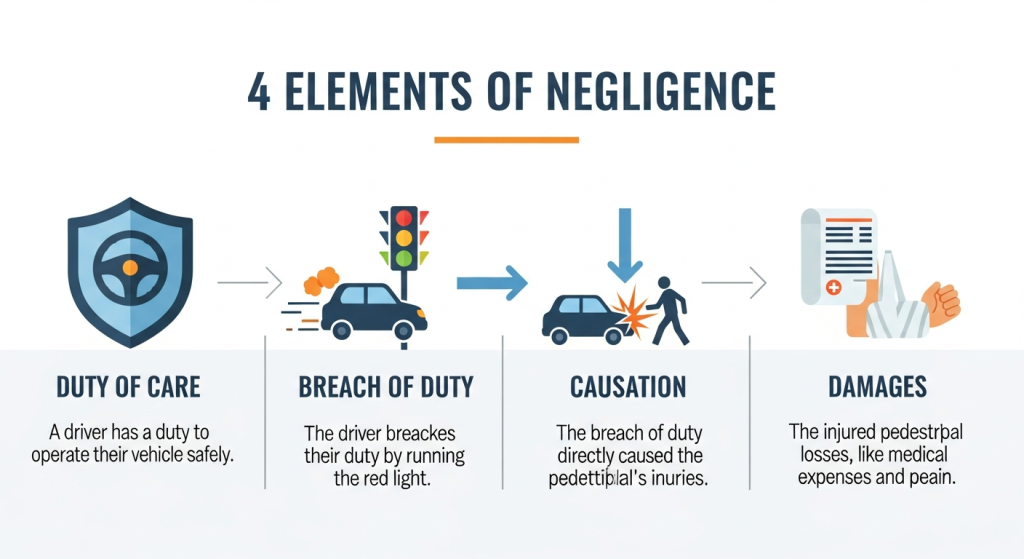
Proving negligence in a Texas personal injury claim requires establishing these four key elements in order.
In Texas, proving negligence requires establishing four key elements:
Without proving all four of these elements, a personal injury claim cannot succeed.
Texas operates under a legal doctrine known as “modified comparative negligence” with a 51% bar rule. This means that you can still recover damages even if you are partially at fault for the accident, as long as your share of the blame is 50% or less. However, your total compensation will be reduced by your percentage of fault. For instance, if you are awarded $100,000 in damages but are found to be 20% at fault, your recovery will be reduced by $20,000, leaving you with $80,000. If you are found to be 51% or more at fault, you are barred from recovering any compensation.
Identifying the liable party is a critical step. Liability can rest with a single individual, such as a negligent driver, or it can extend to multiple parties. For example, in a commercial trucking accident, liability could fall on the truck driver, the trucking company for negligent hiring, the cargo loader, or even the vehicle manufacturer. In a slip and fall at a local retail store, the property owner or management company could be held liable. A thorough investigation is essential to identify all potentially responsible parties to maximize your chances of a full recovery.
While accidents can happen in countless ways, certain types of incidents are more prevalent in a suburban hub like Sugar Land.
Collisions involving cars, trucks, and motorcycles are the most frequent source of personal injury claims. Busy corridors like U.S. 59, Highway 6, and local thoroughfares such as Williams Trace Boulevard see heavy traffic, increasing the risk of accidents caused by distracted driving, speeding, or impairment. While statewide traffic fatalities saw a slight decrease in 2023, Texas still experienced a staggering 4,291 deaths on its roads, underscoring the constant danger.
Due to Sugar Land’s proximity to major commercial routes, accidents involving large commercial trucks are a serious concern. The sheer size and weight of these vehicles mean that collisions often result in catastrophic injuries or fatalities. These cases are complex, often involving federal regulations, multiple liable parties, and aggressive corporate legal teams.
Property owners in Texas have a legal obligation to maintain a reasonably safe environment for visitors. When they fail to do so, they can be held liable for resulting injuries. Common premises liability cases in Sugar Land include slip and falls in grocery stores, trip and falls on uneven sidewalks, swimming pool accidents, or injuries resulting from inadequate security at apartment complexes or shopping centers.
Sugar Land’s growing economy includes numerous construction projects and commercial enterprises. While Texas law is unique in that it does not require all private employers to carry workers’ compensation insurance, injured workers still have rights. If an employer is a “non-subscriber,” an employee can file a personal injury lawsuit directly against them. Even with workers’ comp, a third-party claim may be possible if a non-employer’s negligence caused the injury. The state sees thousands of workplace incidents annually; private industry employers in Texas reported 175,900 nonfatal recordable cases in 2023.
As Sugar Land develops more mixed-use and walkable areas, the risk of pedestrian and bicycle accidents increases. These individuals are extremely vulnerable and often suffer severe injuries when struck by a vehicle. Negligent drivers who fail to yield the right-of-way or are distracted can be held accountable for the harm they cause.
Other significant personal injury cases include dog bites, which hold owners strictly liable under certain conditions, and product liability claims, where a defective or dangerous product causes harm. In the most tragic cases, medical malpractice by a healthcare provider can lead to devastating, life-altering injuries.
The purpose of a personal injury claim is to secure compensation that covers the full scope of your losses. These losses, known as “damages,” are categorized based on their nature.
Injuries can range from moderate to catastrophic. Common examples include traumatic brain injuries (TBIs), spinal cord injuries leading to paralysis, broken bones, severe burns, internal organ damage, and soft tissue injuries like whiplash. These injuries often require extensive medical treatment and can have long-term consequences.
In Texas, an injured victim can seek compensation for two main types of damages:
While a few very high-value cases can skew the numbers, the average settlement for Texas personal injury lawsuits was $826,892, though the median was significantly lower, highlighting how case values vary dramatically.
If a personal injury results in a fatality, eligible surviving family members (typically a spouse, children, or parents) can file a wrongful death lawsuit. This allows them to recover damages for their own losses, such as lost financial support, loss of inheritance, mental anguish, and loss of companionship. A “survival action” can also be brought on behalf of the deceased’s estate to recover damages the victim could have claimed had they lived, such as their medical bills and pain and suffering.
The journey from injury to resolution can be complex and lengthy. Understanding the key stages can help set proper expectations.
An experienced attorney will launch a thorough investigation, gathering police reports, medical records, witness statements, surveillance footage, and other crucial evidence to build a strong foundation for your claim.
Insurance adjusters work for the insurance company, and their primary goal is to minimize payouts. They may try to get you to provide a recorded statement or accept a quick, lowball settlement offer. It is critical to have your attorney handle all communications with insurers to protect your rights.
Most personal injury cases are resolved through a negotiated settlement without ever going to trial. Your lawyer will present a demand package to the insurance company and skillfully negotiate to reach a fair agreement that covers all your damages.
If the insurance company refuses to offer a reasonable settlement, your attorney may recommend filing a lawsuit in the appropriate Fort Bend County court. This initiates the formal litigation process, which includes discovery, depositions, and potentially a trial where a judge or jury will decide the outcome.
In Texas, you generally have two years from the date of the injury to file a personal injury lawsuit. This is a strict deadline. If you fail to file within this period, you will likely lose your right to seek compensation forever.
Attempting to handle a personal injury claim alone while recovering from an injury is a monumental task. Professional legal representation can make all the difference.
An experienced attorney levels the playing field against large insurance companies and their legal teams. They understand the complexities of Texas law, know how to accurately value your claim, and have the resources to build a compelling case on your behalf.
A dedicated attorney handles every aspect of your case, including investigating the accident, collecting evidence, communicating with insurers, negotiating a settlement, and, if necessary, representing you in court. This allows you to focus entirely on your physical and emotional recovery.
Most personal injury lawyers in Sugar Land work on a contingency fee basis. This means you pay no upfront costs or attorney’s fees. The lawyer’s fee is a percentage of the compensation they successfully recover for you. If they don’t win your case, you owe them nothing.
Sustaining a personal injury in Sugar Land can be a life-altering event, but you do not have to face the aftermath alone. Understanding your rights under Texas law is the first step toward seeking justice and securing the financial resources needed for your recovery. From proving negligence and navigating the state’s comparative fault rules to accurately calculating your damages and dealing with insurance companies, the legal process is intricate and challenging. Partnering with a skilled Sugar Land personal injury lawyer provides you with a dedicated advocate committed to protecting your interests and fighting for the maximum compensation you deserve. If you have been injured, taking prompt action to seek both medical care and legal counsel is the most important step you can take to safeguard your future.
An experienced personal injury attorney in Harris County, Galveston County, Fort Bend County, Montgomery County, Brazoria County, Houston, Sugar Land, Missouri City, and Stafford, Texas at Thornton Esquire Law Group, PLLC will take over the case from the very beginning and make sure that you receive fair compensation for your injuries. A personal injury lawyer will help you recover medical expenses, lost wages, pain and suffering, and other losses due to the accident. Contact us today atwww.thorntonesquirelawgroup.com for a free case evaluation consultation.

Click on the button below to login.