
Don't Let Our Cute
Smiles Fool You.
We WIN Legal Fights!
Smiles Fool You.
We WIN Legal Fights!



An unexpected injury can disrupt your life in an instant, creating a cascade of physical, emotional, and financial challenges. When that injury is caused by someone else’s negligence in Sugar Land, Texas, navigating the path to recovery can feel overwhelming. The legal system, with its complex rules and procedures, adds another layer of stress to an already difficult situation. This guide is designed to provide clarity for Sugar Land residents, outlining the fundamentals of personal injury law in Texas, the steps to take after an accident, and the process of seeking the compensation necessary to rebuild your life. Understanding your rights is the first and most critical step toward securing justice and ensuring you are not left to bear the financial burden of another’s carelessness.
Personal injury law, also known as tort law, is a civil area of the legal system designed to protect individuals who have been harmed by the negligent, reckless, or intentional actions of another party. The primary goal of a personal injury claim is to “make the victim whole” again, at least from a financial standpoint. This is achieved by seeking monetary compensation, or damages, for the losses incurred due to the injury. These claims are not criminal proceedings; instead, they are private disputes between individuals or entities, adjudicated within the civil court system to determine fault and award appropriate recompense.
For residents of Sugar Land and the broader Fort Bend County area, understanding personal injury law is crucial for protecting their interests. The region’s bustling economy, significant traffic on highways like US-59 and Highway 6, and numerous commercial centers create environments where accidents can and do happen. When an injury occurs, victims are often confronted by insurance companies focused on minimizing payouts. Knowing your rights under Texas law empowers you to counter these tactics, ensures you follow proper legal procedures, and helps you make informed decisions about your future, whether that involves negotiating a settlement or pursuing a case in the Fort Bend County courts.
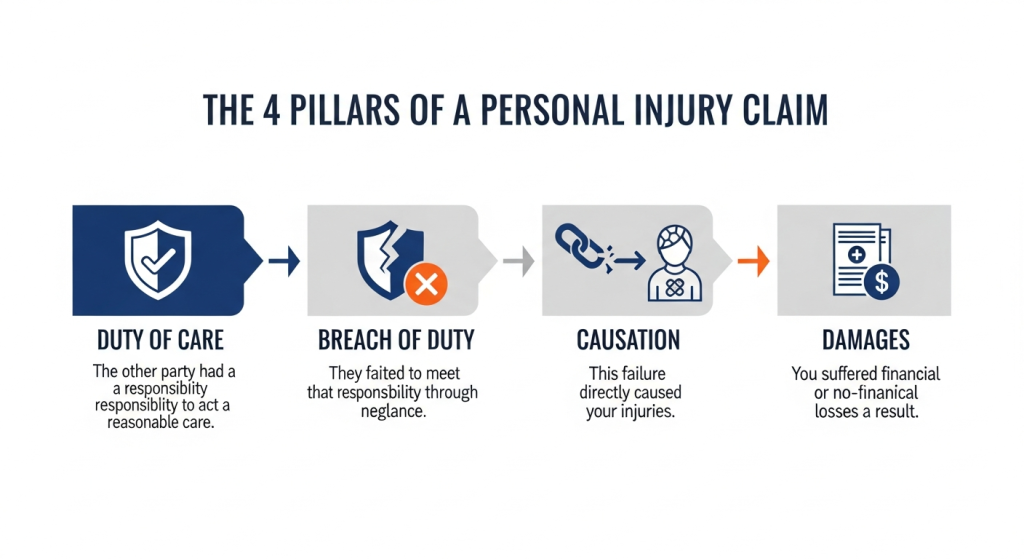
Proving a personal injury claim requires establishing these four key elements: a duty of care was owed, that duty was breached, the breach caused the injury, and the victim suffered actual damages.
(personal injury case, liability)
A personal injury case arises when one person suffers harm from an accident or injury, and someone else might be legally responsible, or have liability, for that harm. The scope is broad, covering a vast range of incidents where negligence is a factor. The central element in any personal injury case is proving that the at-fault party had a duty to act with reasonable care, breached that duty, and directly caused the victim’s injuries and subsequent damages. Liability can fall on an individual, a corporation, a government entity, or another party, depending on the specific circumstances of the incident.
Auto accidents are a primary cause of personal injuries in and around Sugar Land. The sheer volume of traffic in the Houston metropolitan area contributes to a high number of collisions. In 2023, Harris County alone saw 67,644 traffic crashes, illustrating the daily risk drivers face. These incidents, from minor fender-benders to catastrophic vehicle collisions, can result from distracted driving, speeding, or intoxication. The consequences of a serious car accident often include significant medical bills, lost income, and long-term physical pain. Furthermore, state data reveals that an average of 89 Texans were killed every month in alcohol-related crashes in 2023, underscoring the severe dangers of impaired driving.
Slip and fall accidents fall under a category of law known as premises liability. Property owners in Texas have a legal duty of care to maintain a reasonably safe environment for visitors and patrons. When they fail to address hazards like wet floors, uneven surfaces, poor lighting, or cluttered walkways, they can be held liable for injuries that result. A successful slip and fall claim requires proving the property owner knew or should have known about the dangerous condition and failed to take corrective action. These incidents are alarmingly common, accounting for over 1 million emergency room visits annually nationwide, according to the National Floor Safety Institute.
While many workplace injuries are covered by workers’ compensation insurance, some situations allow for a personal injury lawsuit. This is often the case in construction accidents where a third party, such as a subcontractor or equipment manufacturer, is responsible for the injury. It also applies when an employer does not carry workers’ compensation, which is not mandatory for all private employers in Texas. Given that Texas tragically had the most fatal work injuries in 2024 with 58 deaths reported to OSHA, understanding all available legal avenues is vital for injured workers and their families to secure full compensation.
The field of personal injury law also covers several other critical areas. Products liability cases hold manufacturers and sellers accountable for injuries caused by defective or dangerous products. Medical malpractice claims arise when a healthcare provider’s negligence causes harm to a patient; Texas ranked second in the U.S. with over 3,500 such claims filed in 2022. In the most tragic circumstances, where negligence leads to a fatality, surviving family members may file a wrongful death claim to seek justice. These cases often involve serious injuries, such as traumatic brain injuries or spinal cord damage, that have life-altering consequences.
Your health is the absolute priority. After any accident, seek immediate medical attention, even if you feel fine. Some serious injuries, like internal bleeding or concussions, may not have immediate symptoms. Prompt medical care not only starts your physical recovery but also creates crucial medical records that link your injuries directly to the accident. These records are essential evidence for documenting the extent of your harm and justifying future medical expenses.
Formally reporting the incident creates an official record. For a car accident, call 911 so police can respond and create an official police report. For a slip and fall at a business, notify the manager and ensure an incident report is filed. These reports document the time, location, conditions, and parties involved. Officers or managers may also gather initial witness statements, which can be invaluable for establishing what happened.
If you are physically able, document everything. Use your phone to take photographs and videos of the accident scene from multiple angles. Capture property damage to your vehicle, the hazardous condition that caused a fall, and any visible injuries. If there are witnesses, get their names and contact information. Their objective accounts can be powerful in supporting your claim. Do not rely on others to gather this critical evidence for you.
After an accident, you will likely be contacted by an insurance adjuster from the at-fault party’s insurance company. Be cautious. It is their job to minimize the company’s liability. Politely decline to give a recorded statement or discuss fault until you have received legal advice. Anything you say can be misinterpreted and used against your insurance claim later. Simply state that you are not prepared to discuss the incident and will have your representative contact them.
To win a personal injury case in Texas, you must prove four key elements of negligence. First, you must establish that the defendant owed you a duty of care (e.g., a driver’s duty to operate their vehicle safely). Second, you must show they breached that duty through a careless action or inaction. Third, you must prove causation—that the defendant’s breach directly caused your injuries. Finally, you must demonstrate that you suffered actual damages (e.g., medical bills, lost wages) as a result. Establishing all four elements is the foundation of establishing liability.
Texas follows a “modified comparative fault” rule, also known as the 51% bar rule. This means you can still recover damages even if you were partially at fault for the accident, as long as your share of the blame is 50% or less. However, your total compensation will be reduced by your percentage of fault. For example, if you are awarded $100,000 but found to be 20% at fault, your recovery would be reduced to $80,000. If you are found to be 51% or more at fault, you are barred from recovering any damages.
Texas law imposes a strict deadline, known as the statute of limitations, for filing a personal injury lawsuit. In most cases, you have two years from the date of the injury to file a claim. If you miss this deadline, the court will almost certainly dismiss your case, and you will lose your right to seek compensation forever. There are very few exceptions to this rule, making it absolutely critical to act promptly after an injury.
When negligence results in a person’s death, Texas law allows certain surviving family members (spouse, children, and parents) to file a wrongful death claim. This type of lawsuit seeks damages for the losses the family has suffered, such as lost earning capacity, loss of companionship, and mental anguish. It is a civil action meant to provide a measure of justice and financial stability for families who have lost a loved one due to another’s wrongful act.
Economic damages are intended to compensate for verifiable monetary losses. These are tangible, out-of-pocket costs that can be calculated with receipts, bills, and pay stubs. Common examples include all past and future medical expenses, lost wages from time missed at work, loss of future earning capacity if you are disabled, and the cost to repair or replace property damage, such as your vehicle. Any accident-related costs fall into this category.
Non-economic damages compensate for intangible, non-monetary losses related to the injury. These are harder to quantify but are just as real. This category includes compensation for physical pain and suffering, mental anguish, emotional distress, loss of enjoyment of life, disfigurement, and physical impairment. These damages are a crucial part of a victim’s recovery, acknowledging the profound human cost of an injury and providing a form of justice for their suffering.
In rare cases where the defendant’s conduct was particularly egregious—such as gross negligence, malice, or fraud—a court may award punitive damages. Unlike economic and non-economic damages, which are meant to compensate the victim, punitive damages are intended to punish the wrongdoer and deter similar conduct in the future. Texas law places caps on punitive damages, and they are reserved for only the most serious cases.
The vast majority of personal injury cases are resolved through settlements, which are formal agreements reached between the parties outside of court. Litigation can be a lengthy process, and a settlement provides a guaranteed, certain amount of recompense without the risk and expense of a trial. A verdict, on the other hand, is a decision made by a judge or jury after a trial. While a verdict can sometimes result in a higher award, it also carries the risk of a lower award or losing the case entirely.
The process typically begins with an initial consultation with a personal injury attorney. During this meeting, you will discuss the facts of your case, and the attorney will evaluate its merits. This is your opportunity to ask questions and receive preliminary legal advice. If the attorney believes you have a valid claim and you decide to hire them, they become your advocate, working on your behalf as their client.
Once retained, your legal team will launch a comprehensive investigation. This involves collecting all relevant evidence to build a strong case and establish liability. Key tasks include gathering your medical records, obtaining official reports, interviewing witnesses, documenting property damage, and often hiring experts like accident reconstructionists or medical specialists to provide testimony.
After gathering evidence and calculating your damages, your attorney will typically send a demand letter to the at-fault party’s insurance company, officially opening the insurance claim. This begins the negotiation process. The insurance adjuster will review the claim and make a counteroffer. Your attorney will handle all communication, protecting you from adjuster tactics and negotiating skillfully to achieve a fair settlement that covers all your losses.
If the insurance company refuses to offer a fair settlement, it may be necessary to file a lawsuit and enter the litigation phase. This formalizes the dispute within the legal system. The litigation process involves stages like discovery (exchanging evidence), depositions (sworn testimony), and pre-trial motions. While many cases still settle during litigation, your attorney must be prepared to take your case to trial and present it before a judge and jury if a just resolution cannot be reached through negotiation.
Navigating the aftermath of a personal injury in Sugar Land requires a clear understanding of Texas law and a strategic approach to the claims process. From the initial moments after an accident to the complexities of proving negligence and negotiating with insurance companies, every step is critical to protecting your rights and securing a fair outcome. The key takeaways are to prioritize your health, document everything, and understand the legal framework that governs your claim, including Texas’s comparative fault rule and the strict two-year statute of limitations. You do not have to face this journey alone. Seeking professional legal guidance can level the playing field, ensure your case is meticulously prepared, and allow you to focus on your recovery while a dedicated advocate works to secure the justice and compensation you rightfully deserve.
An experienced personal injury attorney in Harris County, Galveston County, Fort Bend County, Montgomery County, Brazoria County, Houston, Sugar Land, Missouri City, and Stafford, Texas at Thornton Esquire Law Group, PLLC will take over the case from the very beginning and make sure that you receive fair compensation for your injuries. A personal injury lawyer will help you recover medical expenses, lost wages, pain and suffering, and other losses due to the accident. Contact us today atwww.thorntonesquirelawgroup.com for a free case evaluation consultation.

Click on the button below to login.