
Don't Let Our Cute
Smiles Fool You.
We WIN Legal Fights!
Smiles Fool You.
We WIN Legal Fights!



Personal Injury in Texas: Your Step-by-Step Guide to Rights and Recovery
An unexpected accident can shatter your sense of security in an instant. One moment, you are navigating your daily life; the next, you are facing physical pain, emotional distress, and a mountain of unforeseen expenses. In Texas, where there were over 560,000 motor vehicle crashes in a single year, the path to recovery can seem daunting. This guide is designed to cut through the confusion, providing a clear, step-by-step roadmap to understanding your rights and securing the recovery you deserve after a personal injury.
The moments following an accident are often chaotic and overwhelming. Your priority is your well-being, but the actions you take can significantly impact your ability to recover compensation for your losses. This period is not just about medical care; it’s about laying the groundwork for a potential personal injury claim. Knowing what to do—and what to avoid—can protect your health and your legal rights from the very start.
Navigating a personal injury claim is not a straightforward process. You will be dealing with insurance companies whose primary goal is to minimize their payout. Without a strategic approach, you risk accepting a lowball settlement that fails to cover the full extent of your damages, including future medical expenses and lost earning capacity. A methodical, informed strategy ensures that you build a strong case, supported by solid evidence, aimed at achieving a fair and just outcome.
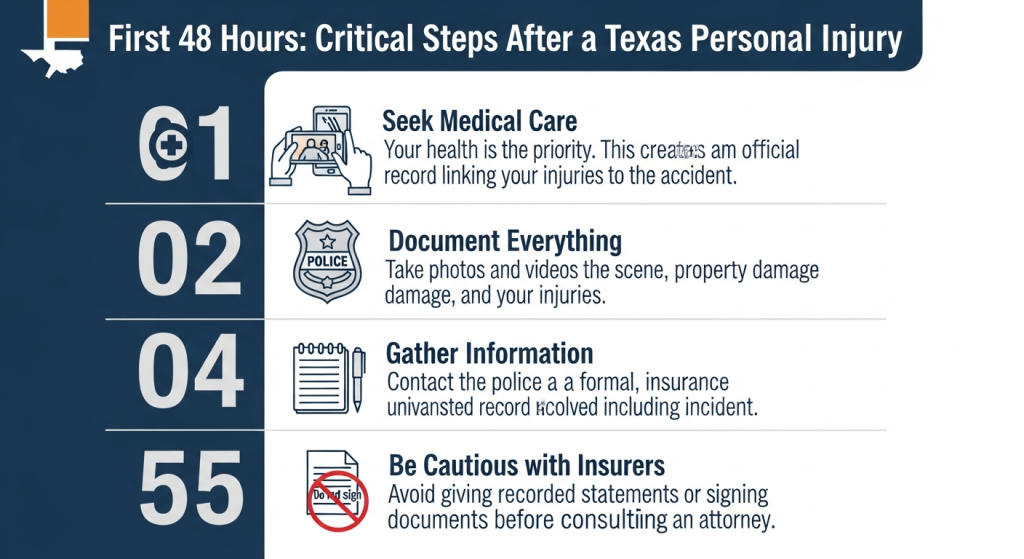
A summary of the crucial first steps to take within 48 hours of an accident to protect both your health and your legal rights.
The first two days after an injury are critical. The steps you take during this window can preserve crucial evidence and establish a clear record of your injuries and the incident that caused them.
Your health is the absolute first priority. Even if you feel your injuries are minor, seek a medical evaluation immediately. Some serious injuries, like internal bleeding or concussions, may not present symptoms right away. Adrenaline can mask pain, giving you a false sense of being okay.
Seeking prompt medical care accomplishes two vital things: it ensures you receive the necessary treatment for a full recovery, and it creates an official medical record linking your injuries directly to the accident. This medical documentation is a cornerstone of any personal injury claim.
If you are physically able, gather as much evidence as possible at the scene. This information can be invaluable later.
In Texas personal injury law, the concept of “duty of care” is fundamental. It refers to the legal obligation individuals have to act with a reasonable level of caution to avoid harming others. When someone breaches this duty—for example, by texting while driving or failing to clean up a spill in a store—and that breach causes an injury, they are considered negligent and may be held liable for the resulting damages.
Once you have addressed your immediate medical needs, the focus shifts to building a comprehensive claim. This phase is about meticulous documentation and careful communication.
Follow your doctor’s treatment plan precisely. Attend all follow-up appointments, physical therapy sessions, and consultations with specialists. Failing to do so can be used by insurance companies to argue that your injuries were not as severe as you claim.
Keep a detailed file of every document related to your accident and injuries. This includes medical bills, pharmacy receipts, correspondence with doctors, and records of any out-of-pocket expenses. It is also wise to keep a simple journal detailing your daily pain levels, physical limitations, and the emotional impact the injury has had on your life.
Evidence is what transforms your story into a compelling legal claim. The initial evidence gathered at the scene is a starting point. A strong personal injury case will also include:
Soon after an accident, you will likely receive a call from the at-fault party’s insurance adjuster. It is critical to be cautious. The adjuster’s job is to protect the insurance company’s bottom line, not to ensure you are fully compensated.
They may sound friendly and helpful, but they are often trained to elicit statements that can be used against you. They may ask for a recorded statement—you are not obligated to provide one. They may also make a quick, low settlement offer before you know the full extent of your injuries and future medical needs. It is best to provide only basic contact information and politely decline further discussion until you have sought legal counsel.
The goal of a personal injury claim is to recover “damages”—the legal term for the compensation you are owed for your losses. These damages are categorized to account for every way the injury has affected your life.
Compensatory damages are intended to make you “whole” again by covering both tangible and intangible losses.
In some rare cases where the defendant’s conduct was particularly reckless or malicious (e.g., a drunk driver causing a severe accident), a Texas court may award punitive damages, known as exemplary damages. These are not meant to compensate the victim for losses but to punish the wrongdoer and deter similar behavior in the future.
Texas follows a “modified comparative fault” rule, also known as the 51% bar rule. This means you can still recover damages even if you were partially at fault for the accident, as long as your share of the fault is 50% or less. However, your total compensation will be reduced by your percentage of fault. If you are found to be 51% or more at fault, you are barred from recovering any damages at all. This rule makes establishing the precise degree of fault a critical part of the legal process.
The journey from filing a claim to receiving a settlement or verdict follows a structured legal process. Understanding these steps can help manage expectations and demystify the experience.
In Texas, you generally have only two years from the date of the injury to file a personal injury lawsuit. This deadline is known as the statute of limitations. If you miss this window, you will almost certainly lose your right to seek compensation through the court system. There are very few exceptions, making it imperative to act promptly after an accident.
After you engage a law firm, their team will conduct a thorough investigation, gathering all evidence needed to build your case. Once the full extent of your damages is known, your attorney will typically send a formal demand letter to the insurance company, outlining your case and the compensation you are seeking. If the insurance company refuses to offer a fair settlement, the next step is to file a formal lawsuit with the court.
Filing a lawsuit initiates the “discovery” phase. During this period, both sides exchange information, including documents, witness lists, and depositions (sworn out-of-court testimony). This phase allows each party to understand the strengths and weaknesses of the other’s case. Negotiations for a settlement often continue throughout this process. Many cases are resolved through mediation, a structured negotiation process facilitated by a neutral third party.
While the vast majority of personal injury cases settle out of court, some cannot be resolved through negotiation. If the insurance company refuses to make a reasonable offer, your legal team must be prepared to take your case to trial. This involves presenting evidence, witness testimony, and legal arguments to a judge and jury, who will then determine fault and the amount of damages. It is crucial to have a law firm with a proven track record of trial success. The difference in outcomes can be significant, as reflected in data showing the average personal injury verdict in Texas at $826,892, while the median award was only $12,281, highlighting how a few large verdicts can skew the average.
Attempting to handle a personal injury claim alone puts you at a significant disadvantage. An experienced attorney and their dedicated team provide the expertise, resources, and advocacy needed to secure a just result.
Insurance companies are multi-billion dollar corporations with teams of adjusters and lawyers dedicated to protecting their profits. A skilled personal injury attorney understands their tactics and how to counter them. They handle all communications, manage deadlines, and build a case designed to withstand the scrutiny of the opposition.
An experienced legal team knows how to accurately calculate the full value of your claim. This goes beyond adding up current bills; it involves projecting future medical costs, quantifying lost earning potential, and placing a fair value on your pain and suffering. Their goal is to ensure your settlement or verdict covers all of your past, present, and future losses.
Most reputable personal injury law firms work on a contingency fee basis. This means you pay no upfront legal fees. The firm’s fee is a percentage of the compensation they recover for you. If they do not win your case, you owe them nothing for their service. This arrangement provides everyone with access to high-quality legal representation, regardless of their financial situation.
Beyond the legal strategy, a good legal team provides essential support and guidance. They handle the administrative burdens of the claim process, allowing you to focus on your physical and emotional recovery. This comprehensive care and service can be invaluable during one of the most challenging times of your life.
Not all law firms are created equal. Selecting the right firm for your specific case is a critical decision that will have a lasting impact on your recovery.
Look for a law firm that specializes in personal injury law and has a deep understanding of Texas-specific statutes and court procedures. Ask about their experience with cases similar to yours and their history of successful settlements and trial verdicts. A proven track record is the best indicator of a firm’s ability to handle your case effectively.
You should feel like a priority, not just another case number. The best firms provide a high level of client service, with open communication and a dedicated team available to answer your questions. They should take the time to understand your unique situation and tailor their legal strategy to your specific needs and goals.
A successful personal injury lawsuit often requires significant resources to fund investigations, hire expert witnesses, and cover litigation costs. Ensure the firm you choose has the financial stability to see your case through to the end. Additionally, a firm’s reputation among judges, opposing counsel, and insurance companies can significantly influence the negotiation process.
The aftermath of a personal injury in Texas can be a complex and intimidating journey, but you do not have to walk it alone. By taking immediate and strategic action—prioritizing medical care, preserving evidence, and understanding the legal landscape—you can protect your rights. The process, from documenting damages and navigating insurance company tactics to meeting the critical statute of limitations, requires diligence and expertise. Partnering with an experienced personal injury law firm levels the playing field, providing the advocacy needed to counter powerful insurance interests and maximize your recovery. By choosing a dedicated team with a proven record, you empower yourself to focus on what matters most: your health and your future.
An experienced personal injury attorney in Harris County, Galveston County, Fort Bend County, Montgomery County, Brazoria County, Houston, Sugar Land, Missouri City, and Stafford, Texas at Thornton Esquire Law Group, PLLC will take over the case from the very beginning and make sure that you receive fair compensation for your injuries. A personal injury lawyer will help you recover medical expenses, lost wages, pain and suffering, and other losses due to the accident. Contact us today atwww.thorntonesquirelawgroup.com for a free case evaluation consultation.

Click on the button below to login.