
Don't Let Our Cute
Smiles Fool You.
We WIN Legal Fights!
Smiles Fool You.
We WIN Legal Fights!



When an unexpected injury disrupts your life, the path to recovery can seem overwhelming, especially amidst the unique hustle of a vibrant coastal city like Galveston. Accidents can happen anywhere, from the busy I-45 corridor to the tourist-filled Seawall, leaving victims with physical pain, emotional distress, and significant financial burdens. In Texas, where motor vehicle crashes occur with alarming frequency, understanding your legal rights is the first step toward reclaiming your stability. With an average of 1,534 accidents per day across the state, knowing how to navigate a personal injury claim in Galveston is not just important—it’s essential.
This guide provides a comprehensive overview of personal injury law in Galveston, Texas, covering the types of cases common to the area, the legal principles that govern them, and the critical steps you should take to protect your rights and secure the compensation you deserve.
In legal terms, a personal injury case arises when one person suffers harm from an accident or injury, and someone else might be legally responsible for that harm. The core of any personal injury claim is the concept of negligence or an intentional wrongful act. This area of civil law, also known as tort law, allows an injured party to seek financial compensation, or “damages,” from the at-fault party to cover the losses resulting from the incident. These losses can range from medical expenses and lost income to pain and suffering.
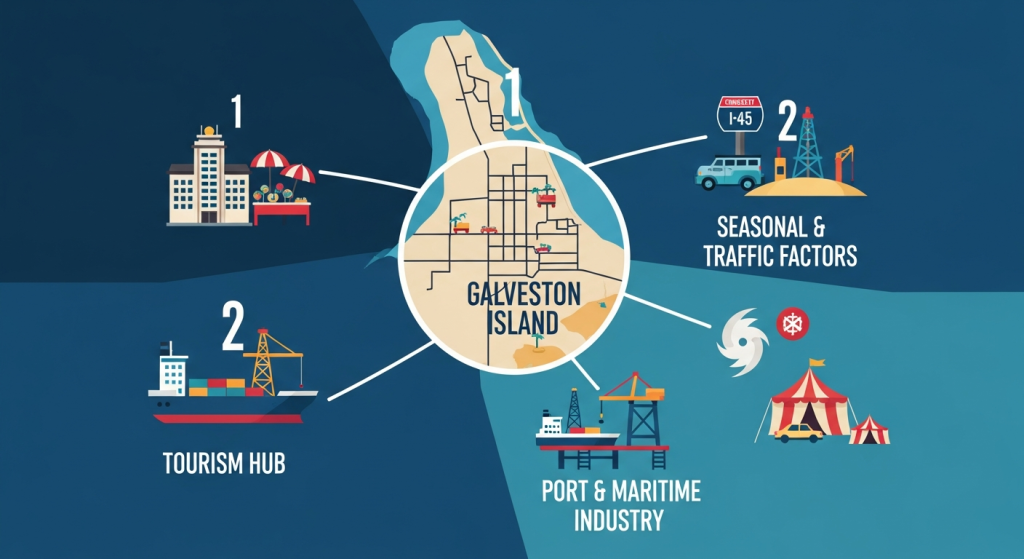
Galveston’s unique blend of tourism, port activity, and seasonal events creates a distinct landscape for personal injury risks.
Galveston is not a typical Texas city. Its status as a major tourist destination, a bustling port city, and a hub for offshore industry creates a unique landscape for personal injury claims. The constant influx of visitors means a higher potential for accidents in hotels, restaurants, and entertainment venues. The Port of Galveston’s operations introduce complex maritime and industrial accidents governed by specific federal laws like the Jones Act. Furthermore, seasonal events and weather patterns can impact road conditions and premises safety, adding layers of complexity to proving liability in an injury case.
Roadways in and around Galveston, including I-45, Broadway Avenue, and the Seawall Boulevard, see a high volume of local, commercial, and tourist traffic. This congestion leads to a significant number of car, truck, motorcycle, and pedestrian accidents. Common causes include distracted driving, speeding, driving under the influence (DUI), and failure to yield. The consequences of these collisions can be devastating, contributing to Texas’s high rate of traffic-related fatalities.
Given its location on the Gulf Coast, Galveston is a center for maritime commerce and offshore energy production. Workers in these industries face significant risks. Injuries sustained on docks, container ships, cruise liners, or offshore oil rigs fall under a specialized area of law. Federal statutes like the Jones Act provide protections for seamen injured due to employer negligence, while other laws cover longshoremen and harbor workers. These cases require specific legal expertise distinct from standard personal injury claims.
Property owners in Galveston have a legal duty to maintain a reasonably safe environment for visitors, customers, and tenants. When they fail to do so, accidents can occur. Premises liability claims arise from incidents like slip and falls on wet floors in a restaurant, trip and falls over uneven pavement on a hotel walkway, swimming pool accidents, or injuries caused by negligent security at a commercial property. Proving the property owner knew or should have known about the hazard is central to these cases.
Beyond the port, Galveston has numerous construction sites and industrial facilities where workers are exposed to hazards. Accidents involving heavy machinery, falls from heights, exposure to toxic substances, or equipment malfunctions can cause severe and life-altering injuries. While workers’ compensation may provide some benefits, a third-party liability claim may be possible if someone other than the employer, such as a negligent contractor or equipment manufacturer, was responsible for the injury.
When healthcare professionals fail to provide the accepted standard of care and cause harm to a patient, it may constitute medical malpractice. These complex cases can involve surgical errors, misdiagnosis, birth injuries, or medication mistakes. Proving that a doctor’s or hospital’s negligence directly caused the injury requires extensive medical evidence and expert testimony.
The most tragic personal injury cases are those that result in a fatality. When a person’s death is caused by the negligence or wrongful act of another, eligible surviving family members can file a wrongful death claim. In 2023, Galveston County had 35 fatal crashes resulting in 39 fatalities, underscoring the severe reality of such incidents. These claims seek compensation for losses such as lost income, loss of companionship, and funeral expenses.
To succeed in a personal injury claim in Texas, the injured party (the plaintiff) must prove that the at-fault party (the defendant) was negligent. This involves establishing four key elements:
Texas follows a “modified comparative fault” rule, also known as the 51% bar rule. This means an injured person can recover damages only if they are found to be 50% or less at fault for the accident. If they are found to be 51% or more at fault, they are barred from recovering any compensation. If they are 50% or less at fault, their recovery is reduced by their percentage of fault. For example, if you are awarded $100,000 but found to be 20% at fault, your award will be reduced to $80,000.
In Texas, the statute of limitations for most personal injury claims is two years from the date the injury occurred. This is a strict deadline. If you fail to file a lawsuit within this two-year window, you will almost certainly lose your right to seek compensation through the court system. There are very few exceptions to this rule, making it critical to act promptly after an accident.
Personal injury lawsuits in Galveston are filed in the Galveston County court system. Navigating the local court rules, procedures, and personnel requires specific knowledge and experience. A lawyer familiar with the local judiciary and opposing counsel can provide a significant advantage in managing the case, from filing the initial complaint to negotiating with opposing parties and, if necessary, presenting the case to a local jury.
Economic damages are intended to compensate for the direct financial losses resulting from an injury. They are quantifiable and can be proven with documentation like bills, receipts, and employment records. These damages include:
Non-economic damages compensate for the non-financial, subjective losses an injury victim endures. While harder to quantify, they are a crucial part of a personal injury award. These damages cover:
Punitive damages (or exemplary damages) are not intended to compensate the victim but rather to punish the defendant for particularly egregious behavior and deter similar conduct in the future. In Texas, they are rare and only awarded in cases involving gross negligence, malice, or fraud.
The vast majority of personal injury cases are resolved through a negotiated settlement with the at-fault party’s insurance company. A settlement avoids the time, expense, and uncertainty of a trial. However, if the insurance company refuses to offer a fair settlement, taking the case to trial may be necessary to secure just compensation. While the average personal injury settlement in Texas is approximately $22,000, every case is unique, and the value depends entirely on the specific facts and damages involved.
Your health is the top priority. After an accident, move to a safe location if possible and call 911. Seek immediate medical evaluation, even if you don’t feel seriously injured. Some injuries, like internal bleeding or traumatic brain injuries, may not have immediate symptoms. A medical record also creates a crucial link between the accident and your injuries.
If you are able, document everything. Take photos and videos of the accident scene, your injuries, property damage, and any relevant conditions (e.g., a wet floor, a broken handrail). Get the names and contact information of any witnesses. This evidence can be invaluable later.
Report the accident to the appropriate authorities. For a car crash, call the Galveston Police Department or Sheriff’s Office. For a workplace injury, report it to your supervisor immediately. For a slip and fall, notify the property manager. An official report creates a formal record of the incident.
You will likely be contacted by an insurance adjuster from the at-fault party’s provider. Be cautious. It is advisable to provide only basic information and avoid giving a recorded statement or accepting any early settlement offers until you have consulted with an attorney.
Insurance companies are businesses focused on minimizing payouts. An experienced attorney understands their tactics and can handle all communications on your behalf, protecting you from saying something that could be used against you and ensuring you are not pressured into an unfair settlement.
A Galveston attorney brings a deep understanding of Texas personal injury statutes, comparative fault rules, and relevant case precedents. They are familiar with the local Galveston County court system and can build a legal strategy tailored to the specific circumstances of your case and the local legal environment.
An attorney has the resources to conduct a thorough investigation, gather critical evidence, hire expert witnesses (such as accident reconstructionists or medical experts), and accurately calculate the full value of your damages. Their primary goal is to build a compelling case to prove liability and secure the maximum compensation available for your recovery.
Sustaining a personal injury in Galveston can be a disorienting and challenging experience. The combination of physical recovery, financial strain, and legal complexity can feel insurmountable. However, you do not have to face this journey alone. Understanding the fundamentals of Texas personal injury law—from establishing negligence and adhering to the statute of limitations to knowing the types of compensation you are entitled to—empowers you to take control of your situation.
The most critical step is to protect your rights by seeking timely medical care, documenting everything, and consulting with a qualified Galveston personal injury attorney. A local legal professional can navigate the complexities of your claim, stand up to insurance companies, and advocate tirelessly on your behalf, allowing you to focus on what matters most: your health and well-being. By taking decisive action, you can work toward securing the justice and financial resources necessary to rebuild your life.
An experienced personal injury attorney in Harris County, Galveston County, Fort Bend County, Montgomery County, Brazoria County, Houston, Sugar Land, Missouri City, and Stafford, Texas at Thornton Esquire Law Group, PLLC will take over the case from the very beginning and make sure that you receive fair compensation for your injuries. A personal injury lawyer will help you recover medical expenses, lost wages, pain and suffering, and other losses due to the accident. Contact us today atwww.thorntonesquirelawgroup.com for a free case evaluation consultation.

Click on the button below to login.