
Don't Let Our Cute
Smiles Fool You.
We WIN Legal Fights!
Smiles Fool You.
We WIN Legal Fights!



When an unexpected injury disrupts your life, the path forward can seem overwhelming. In a dynamic and growing community like Sugar Land, Texas, the risk of accidents is an unfortunate reality of daily life. In 2023 alone, Sugar Land experienced approximately 1,812 total traffic crashes, underscoring the potential for serious incidents on local roadways. If you or a loved one has been harmed due to someone else’s carelessness, understanding your rights is the first and most critical step toward recovery and justice. This guide provides a comprehensive overview of personal injury law in Sugar Land, designed to help you navigate the complexities of your claim with clarity and confidence.
Personal injury law, also known as tort law, provides a legal framework for individuals who have been physically or psychologically injured as a result of the negligence or wrongful act of another person, company, or entity. The primary goal of a personal injury claim is to secure financial compensation, known as damages, for the victim. This compensation is intended to cover the various losses incurred due to the injury, helping the victim become “whole” again, at least from a financial perspective. It is a civil action, distinct from criminal charges, focused on restoring the injured party’s stability and holding the responsible party accountable.
While Texas state law governs personal injury claims, local factors in Sugar Land and Fort Bend County can significantly influence a case. The city’s rapid growth, heavy traffic along major arteries like I-69, and bustling commercial centers create specific risk environments. A local attorney’s familiarity with Fort Bend County’s court system, its judges, and the tactics employed by local insurance adjusters can be an invaluable asset. Understanding the community’s character and the specific accident hotspots provides a strategic advantage in building a compelling and contextually relevant case.
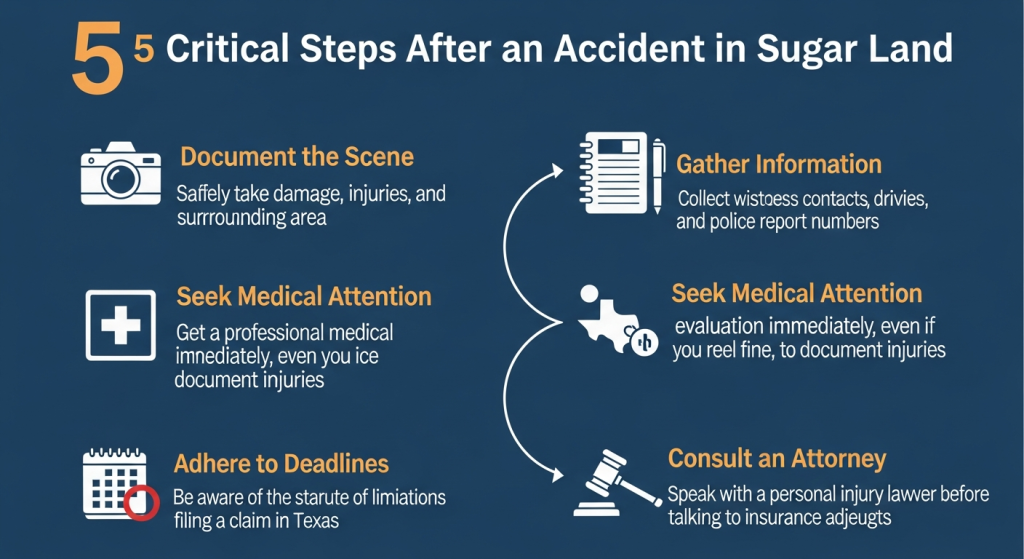
Following these crucial steps immediately after an accident can protect your health and strengthen your personal injury claim.
Following an injury, time is of the essence. The decisions made in the hours and days after an accident can have a profound impact on your ability to recover fair compensation. Prompt action allows for the preservation of critical evidence, such as photographs of the scene, witness contact information, and official reports. Seeking immediate medical attention not only prioritizes your health but also creates an official record linking the accident to your injuries. Delaying action can weaken your claim, as evidence may disappear, memories may fade, and insurance companies may argue that your injuries are not as severe as you claim.
As a major hub within the Houston metropolitan area, Sugar Land sees a significant volume of traffic, making vehicle accidents a primary source of personal injury claims. Statewide, Texas saw an average of 1,534 motor vehicle crashes per day in 2023. These incidents range from minor fender-benders to catastrophic collisions involving cars, large commercial trucks, motorcycles, pedestrians, and cyclists. Common causes include distracted driving, speeding, failure to yield, and driving under the influence. In 2023, crashes where a driver was under the influence of alcohol accounted for 25% of all traffic fatalities in Texas.
Property owners and managers in Sugar Land have a legal duty to maintain a reasonably safe environment for visitors. When they fail to do so, slip, trip, and fall accidents can occur. These premises liability cases often arise from hazards like wet floors without warning signs, uneven pavement, poor lighting, or cluttered walkways in retail stores, restaurants, and other public spaces. Proving the property owner knew or should have known about the dangerous condition is key to a successful claim.
While many on-the-job injuries are covered by workers’ compensation, some situations may warrant a personal injury lawsuit. This is often the case when an injury is caused by the negligence of a third party (not your employer or a co-worker), such as a subcontractor on a construction site or the manufacturer of faulty equipment. In 2023, Texas private industry employers reported 175,900 total recordable nonfatal cases, highlighting the persistent risk of workplace accidents.
Consumers have a right to expect that the products they purchase are safe for their intended use. When a product with a design, manufacturing, or marketing defect causes an injury, the manufacturer, distributor, or retailer can be held liable. Product liability claims can involve a wide range of items, from defective auto parts and medical devices to unsafe children’s toys and household appliances.
Medical malpractice occurs when a healthcare professional—such as a doctor, nurse, or hospital—deviates from the accepted medical standard of care, resulting in patient harm. These complex cases can stem from surgical errors, misdiagnosis, birth injuries, or medication mistakes. Proving a breach in the standard of care requires meticulous investigation and testimony from qualified medical experts to establish that the provider’s negligence directly caused the patient’s injury.
At the heart of most personal injury cases is the legal concept of negligence. To win your case, you must prove four specific elements. First, you must establish that the at-fault party owed you a “duty of care.” For example, every driver has a duty to operate their vehicle safely. Second, you must show that the party “breached” that duty through a careless or reckless act, such as running a red light. The final two elements, causation and damages, link this breach directly to the accident and the harm you suffered.
Liability refers to the legal responsibility for an accident and the resulting injuries. Determining who is liable can be straightforward, as in a simple rear-end collision, or highly complex, potentially involving multiple parties. For example, in a commercial truck accident, liability could fall on the driver, the trucking company, the vehicle manufacturer, or the cargo loader. A thorough investigation is crucial to identify all potentially liable parties to ensure you can pursue full compensation for your losses.
Texas law follows a “modified comparative fault” rule, also known as proportionate responsibility. This means you can still recover damages even if you were partially at fault for the accident, as long as your share of the blame is 50% or less. However, your total compensation will be reduced by your percentage of fault. If you are found to be 51% or more responsible, you are barred from recovering any damages. This rule makes it critical to counter attempts by insurance companies to shift undue blame onto you.
Personal injury accidents can result in a wide spectrum of serious injuries that may have lifelong consequences. These often include traumatic brain injuries (TBIs), spinal cord injuries leading to paralysis, severe burns, amputations, internal organ damage, and complex bone fractures. Beyond the immediate physical trauma, victims often face chronic pain, emotional distress, and a diminished quality of life.
In a successful personal injury claim, you can recover compensation for various losses, categorized as damages. Economic damages are tangible, calculable losses, including all past and future medical bills, lost wages, and loss of future earning capacity. Non-economic damages compensate for intangible suffering, such as physical pain, mental anguish, disfigurement, and loss of enjoyment of life. In rare cases of extreme negligence, punitive damages may be awarded to punish the defendant and deter similar conduct. While every case is unique, a study by Jury Verdict Research calculated the median personal injury settlement in Texas to be $12,281, though verdicts can be significantly higher.
When negligence leads to a fatal accident, surviving family members (typically a spouse, children, or parents) may file a wrongful death claim. This type of lawsuit seeks compensation for the losses they have suffered due to their loved one’s death. Recoverable damages can include lost financial support, loss of companionship and guidance, mental anguish, and funeral and burial expenses. It is a legal means for families to seek justice and financial stability after a devastating loss.
In Texas, the statute of limitations for most personal injury claims is two years from the date of the accident. If you fail to file a lawsuit within this two-year window, you will likely lose your right to seek compensation forever. There are very few exceptions to this rule, making it imperative to act quickly to protect your legal rights.
After an accident, you will likely deal with insurance companies. It is crucial to remember that their primary goal is to protect their own financial interests by minimizing or denying your claim. Adjusters may try to get you to provide a recorded statement to use against you or offer a quick, lowball settlement before the full extent of your injuries is known. Having an attorney handle all communication with insurance companies is the best way to protect yourself.
The vast majority of personal injury claims are resolved through a settlement, which is a formal agreement reached through negotiation between your attorney and the insurance company. If a fair settlement cannot be reached, your attorney may recommend filing a lawsuit and proceeding to litigation. While a trial is possible, most cases still settle before reaching a courtroom verdict.
Insurance companies have teams of experienced lawyers and adjusters dedicated to limiting payouts. An experienced personal injury attorney levels the playing field, acting as your advocate to protect your rights. They understand the tactics insurers use and can effectively counter them to fight for the full compensation you deserve.
Texas’ personal injury laws are complex, with intricate rules regarding negligence, liability, and damages. A skilled attorney provides expert guidance through this legal maze, ensuring your case is built on a solid legal foundation and that all procedural requirements and deadlines are met.
An attorney’s primary objective is to maximize your recovery. They will conduct a thorough investigation to identify all sources of compensation, accurately calculate the full value of your damages (including future needs), and build a powerful case to support your claim. This pursuit of maximum compensation is fundamental to achieving justice for the harm you have suffered.
A local Sugar Land law firm offers distinct advantages. Their attorneys are familiar with Fort Bend County’s legal landscape, including the tendencies of local judges and opposing counsel. They understand the specific challenges and accident patterns within the community, providing tailored and effective representation for each client. This local expertise can make a significant difference in the outcome of your case.
If you have been injured in an accident in Sugar Land, you do not have to face the recovery process alone. Taking the step to speak with a qualified personal injury attorney can provide you with the clarity and direction you need. Most reputable firms offer a free, no-obligation consultation to review your case, explain your legal options, and answer your questions. This initial meeting is a risk-free opportunity to understand your rights and determine the best path forward to secure the justice and compensation you deserve.
An experienced personal injury attorney in Harris County, Galveston County, Fort Bend County, Montgomery County, Brazoria County, Houston, Sugar Land, Missouri City, and Stafford, Texas at Thornton Esquire Law Group, PLLC will take over the case from the very beginning and make sure that you receive fair compensation for your injuries. A personal injury lawyer will help you recover medical expenses, lost wages, pain and suffering, and other losses due to the accident. Contact us today atwww.thorntonesquirelawgroup.com for a free case evaluation consultation.

Click on the button below to login.